

What is organizing for power?
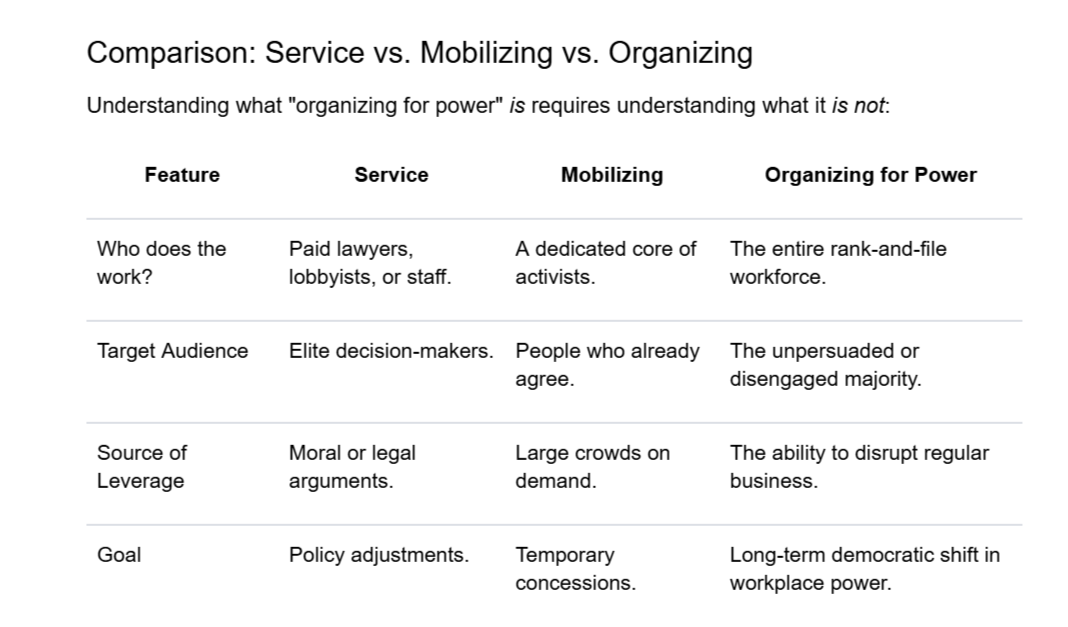
MNA has worked to transition away from a service model towards an organizing model. Away from a strategy of staff leading work towards member-leaders driving our work. At this stage of our transitional journey, we have become a mobilizing Union in which a small group of dedicated member leaders make our decisions, drive turnout for mass actions, and in which we can have wins and extract concessions from management. But this approach is no longer enough to counter the immense resources of billion dollar multi state hospital corporations. To win, we need to continue to transform ourselves from a mobilizing Union to a true organizing Union and organize for power.
Organizing for power means shifting responsibility within our Union to the rank and file. True leverage does not come from a well-worded grievance or even an informational picket with a huge turnout; it comes from our ability to collectively disrupt business as usual. When we achieve overwhelming participation—where 90% to 100% of our coworkers stand together—management is forced to concede to our demands. This is not a radical dream; it is a highly disciplined, step-by-step strategy to continue to grow our collective strength from the ground up.
Step-by-Step Method
1. Mapping and Charting
Workplace Mapping: Draw physical layouts of every department, shift, and workstation.
Charting Connections: List every worker to track social networks and identify who listens to whom.
Identifying Organic Leaders: Spot the un-official leaders who naturally command the respect of their peers.
2. Structure Tests
Low-Stakes Testing: Gauge collective strength using small, measurable actions like signing a petition.
Escalating Actions: Move to larger visible displays like wearing matching buttons on a specific day.
Participation Assessment: Review charts to see which departments failed the test, highlighting where organizing work is still needed.
3. One-on-One Organizing Conversations
Active Listening: Focus conversations on the coworker's specific workplace frustrations and desires for dignity.
Meeting members where they are at and understanding the connection between everyone's priorities.
Agitation: Connect individual issues to the broader structure of employer control.
The Explicit Ask: End every conversation by asking the coworker to take a specific, measurable action.
4. Collective Bargaining and Direct Action
Big Bargaining: Bring large groups of rank-and-file workers directly into negotiation rooms rather than relying on closed-door staff talks.
Credible Strike Threat: Use continuous structure tests to prove that the workforce is disciplined enough to stop production if necessary.
Organizing for power is a labor strategy focused on building overwhelming collective participation to force management to concede to our demands. Unlike traditional methods that rely on staff or even a small group of activists, this approach places ownership entirely in the hands of the rank-and-file workforce. True leverage is achieved only when the vast majority of our members— 90% or more—commit to taking collective action. We have made great strides in our transition towards becoming an organizing model Union, now let's finish the journey. We can do it together!